St. Johns County votes 3-2 to deny North Palm Valley agricultural enclave certification
ST. JOHNS COUNTY, Fla. — The St. Johns County Board of County Commissioners voted 3-2 Tuesday to deny agricultural-enclave certification for the controversial 4,462-acre North Palm Valley property, delivering a significant decision in one of the county’s most closely watched growth battles.
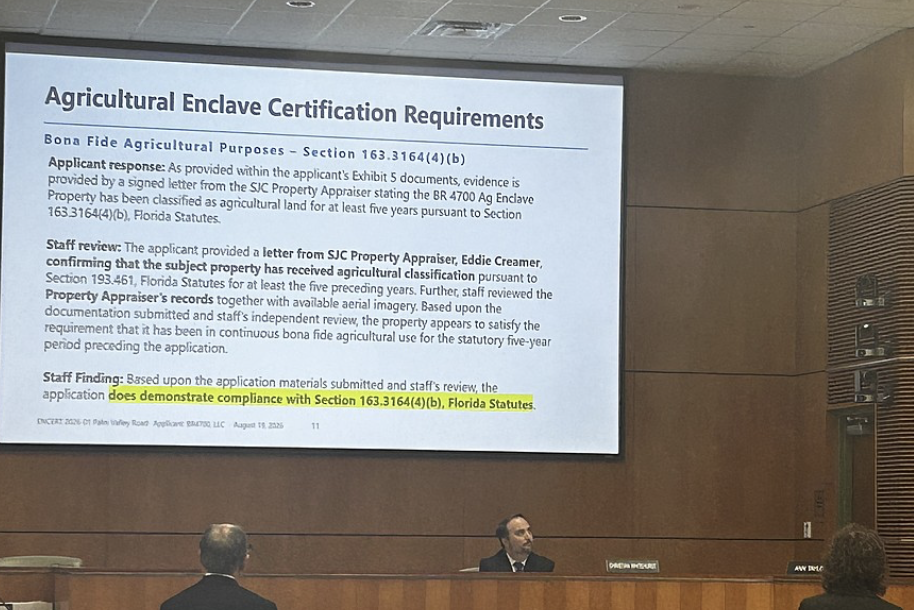
The Sept. 15 vote formally denies ENCERT 2026-01, an application seeking to have approximately 4,462 acres north of Nocatee Parkway certified as an agricultural enclave under Florida’s newly revised agricultural-enclave law.
The property stretches north of Nocatee, west of the Intracoastal Waterway and east of the Duval County line. County records list BR4700 LLC as the owner. The application was filed July 1, the same day the new state law took effect.
The applicant requested a residential density of one dwelling unit per gross acre, potentially allowing roughly 4,462 homes if future development plans were ultimately submitted and approved under the process created by the law. County records list a statutory maximum density of six units per acre, although that was not the density requested in the application.
What did commissioners actually deny?
Tuesday’s vote was not a conventional rezoning vote and did not involve approval or denial of a specific 4,462-home subdivision plan.
Instead, commissioners were deciding whether the property qualified for certification as an “agricultural enclave” under Florida Senate Bill 686, which took effect July 1.
That distinction matters.
Under the revised state law, once land is certified as an agricultural enclave, the property owner may submit plans for single-family residential development consistent with qualifying neighboring land uses. The statute says such development must then be treated as a conforming use, even when it is inconsistent with the county’s existing comprehensive plan, future land-use designation or zoning.
The law also limits the county's ability to require another lengthy public-review process. After development plans are submitted, the county and landowner must establish a review schedule, and the statute specifically restricts additional quasi-judicial hearings for those plans.
That is one reason the Palm Valley certification battle attracted such intense attention from residents concerned about growth, roads, schools, utilities and the future of one of northern St. Johns County's largest remaining undeveloped properties.
A major change from the Sept. 1 deadlock
The decision comes just two weeks after commissioners were unable to reach a final decision on the same application.
At the Sept. 1 meeting, Commissioner Krista Joseph moved to deny certification. Joseph and Commissioner Ann Taylorsupported denial, while Commissioners Clay Murphy, Christian Whitehurst and Sarah Arnold voted against that motion.
The board then considered the opposite motion — approving the agricultural-enclave certification.
That motion also failed 3-2. Whitehurst and Arnold supported certification, while Murphy joined Joseph and Taylor in voting against approval.
The result was an unusual stalemate: the board had neither approved nor denied the application.
That distinction carried enormous consequences because SB 686 contains a 90-day automatic-certification provision.
Under Florida Statute 163.3162, if a local government does not approve or deny an agricultural-enclave application within 90 days of receiving it, the property “must be certified” as an agricultural enclave.
With the North Palm Valley application filed July 1, the county was approaching that deadline later this month.
Tuesday’s formal denial prevents the application from simply reaching the deadline without a decision.
The fight may not be over
A county denial does not necessarily end the case.
Florida law requires the county to issue a written decision containing detailed findings of fact and conclusions of lawwhen it denies agricultural-enclave certification.
The applicant then has 30 days after the county renders its decision to seek review by filing a petition for writ of certiorari in circuit court.
That means the next chapter of the Palm Valley fight could move from the County Auditorium to the courthouse.
There is also a broader legal battle developing over SB 686 itself.
During the Sept. 1 meeting, commissioners separately voted 3-2 to retain outside counsel and pursue legal action challenging the state agricultural-enclave law, potentially including an attempt to obtain injunctive relief.
Why SB 686 has caused so much controversy
The Florida Legislature overwhelmingly approved SB 686 earlier this year. The bill passed the Senate 34-2 and the House 90-20 and became Chapter 2026-34 of Florida law.
The legislation took effect July 1, 2026. Its special agricultural-enclave provisions are scheduled to expire Jan. 1, 2028, unless lawmakers take additional action.
Supporters of the legislation say it provides a clearer path for agricultural properties that have effectively become surrounded by urban development.
Critics argue that it removes too much authority from local governments and can allow major residential projects to move around the traditional comprehensive-plan amendment and public-hearing process.
That debate has become particularly intense in fast-growing St. Johns County.
Palm Valley proposal is one of several agricultural-enclave applications
North Palm Valley is also not the only property seeking to use the new law.
County records show numerous agricultural-enclave applications have been submitted since July, including properties identified as Sandy Creek, AFI Property, Entrada, Adler Creek, Star IV, Pacetti Oaks, Carter Road Associates and Osceola Lakes.
Two other applications — Heritage Development East and Heritage Development West — were certified by commissioners in August.
That means Tuesday's Palm Valley decision could have implications far beyond one property.
How the county writes its findings, whether the applicant challenges the denial and how the courts interpret the new state statute could help determine how St. Johns County handles the growing list of agricultural-enclave requests that follow.
What happens next?
For now, the North Palm Valley property has not been certified as an agricultural enclave.
The county must prepare its written findings supporting Tuesday's denial.
The property owner may challenge that decision in circuit court, while St. Johns County is simultaneously considering its own legal challenge to the state law that created the expedited certification process.
For residents who have packed commission meetings and followed the Palm Valley proposal for weeks, Tuesday’s 3-2 vote is a major decision.
But it may not be the final one.